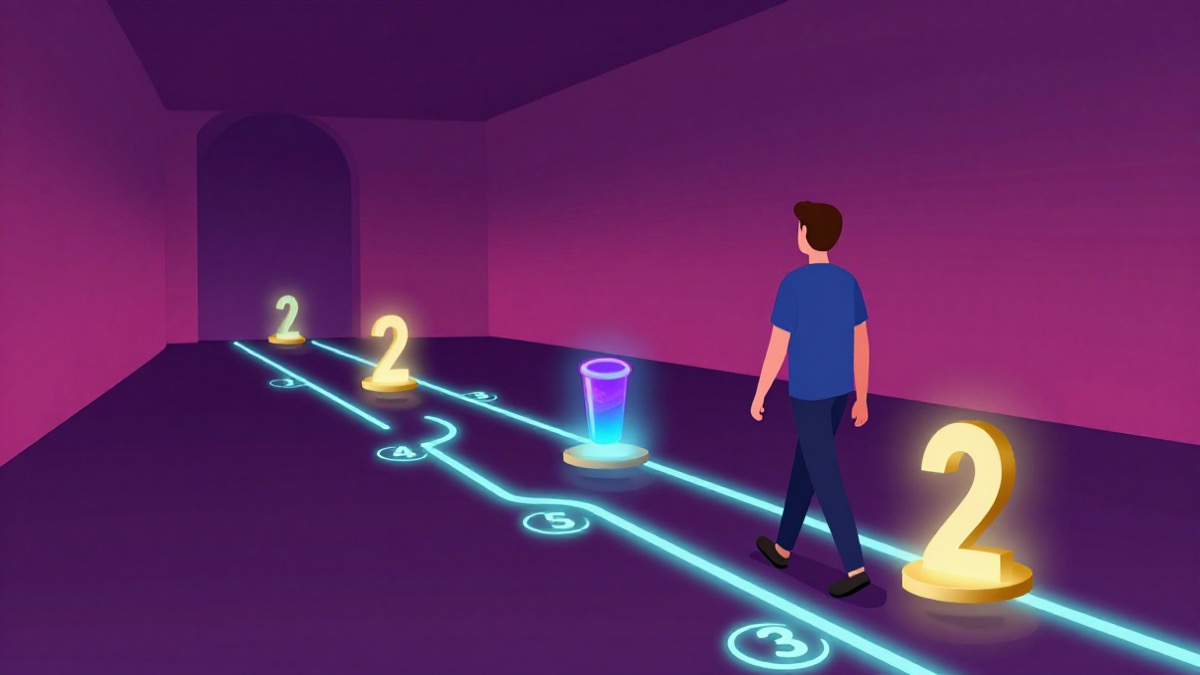
Some memory techniques are gimmicks. The memory palace — also called the method of loci — is not. It is a technique with roots in ancient Greece, a documented history spanning two millennia, and a scientific evidence base that has only strengthened with modern research. And far from being obsolete in an age of search engines and note apps, it remains one of the most reliable ways to memorize ordered information you actually need to hold in your head.
The memory palace technique, also called the method of loci, is one of the most powerful and oldest memory systems known.
The Origins and the Principle
The method of loci is attributed to the Greek poet Simonides of Ceos, who — according to legend — reconstructed the seating positions of guests after a building collapsed by recalling where each had been sitting. From that accident grew a systematic method: place the items you want to remember along a familiar route or location, each attached to a distinct spot, and retrieve them by walking the route mentally.
The principle has a simple scientific basis. Your brain is exceptionally good at remembering places — spatial memory is ancient, robust, and effortlessly learned. By anchoring to-be-remembered content to familiar spatial locations, you borrow that spatial strength to carry arbitrary material. Modern studies of memory champions confirm that nearly all of them use some form of this method, and brain imaging shows the technique recruits regions involved in spatial navigation.
Why It Works
Three converging reasons explain the method’s power:
- It converts the abstract into the concrete and imageable. The method of loci forces you to turn each item into a vivid mental image — which is precisely what makes memory stick, as concrete imagery is recalled far better than abstract tokens.
- It borrows effortless spatial memory. You do not need to memorize a palace’s layout if you already know it — your own home, your commute, a childhood street. The retrieval route is pre-learned for free.
- It preserves order. A place has a natural sequence — walk the route and items appear in order. This is the method’s special strength over other mnemonic tricks: it is a list that cannot get scrambled.
Crucially, the images you build do not need to be realistic or sensible. In fact, the more bizarre, exaggerated, and emotional the image, the more memorable it becomes — a principle that underpins the whole mnemonic tradition.
A Simple, Concrete Example
Suppose you need to remember a short list: apple, umbrella, fountain, violin, candle. Use the rooms of your own apartment as the palace.
- Front door: a giant apple wedged in the doorframe.
- Entry hallway: an umbrella crashing down the stairs.
- Living room: a fountain bubbling up from the sofa.
- Kitchen: a violin conducting the kettle’s whistle.
- Balcony: a candle burning on the railing.
To recall, mentally walk: door → apple, hallway → umbrella, and so on. The absurdity of each image is what makes it unforgettable — and because the locations have a fixed order, the list comes back in order every time.
How to Build a Memory Palace, Step by Step
- Choose a well-known place. Your home, a frequent route, a school you know intimately — pick somewhere you can mentally walk with your eyes closed. A route is often easier than a single room, because it supplies order.
- Define a fixed sequence of loci. Walk the place and number the spots in the order you naturally encounter them — 10 to 20 loci is a good starting palace. Commit the sequence once.
- Make each item a vivid image. Turn every item you want to memorize into a concrete, exaggerated, moving image. Abstract items need a concrete stand-in (e.g., “justice” as a judge’s gavel).
- Place one image per locus. Attach each image to its spot, making the pairing as bizarre or interactive as possible.
- Walk the route to retrieve. Mentally retrace the path in order, “seeing” each image and decoding it back to the item.
- Reuse and extend. One palace can hold many different lists — clear the images, and the same loci can serve again. Add more palaces for more material.
Practical Uses in 2026
The memory palace is not only for circus-style memory feats; it has everyday applications that are genuinely useful:
- Ordered lists that must be reproduced exactly: the periodic table segments, anatomical structures in order, historical timelines, the sequence of steps in a procedure or presentation.
- Public speaking and presentations: a palace encodes your talking points in order, so you can deliver without notes and never lose your place.
- Exam review for structured material: sequences, cycles, and lists are the method’s home turf; combine with other evidence-based techniques for depth.
- Names and faces: attaching a name to a striking image tied to a location is a practical variant.
- Vocabulary and foreign terms: pair a new word with a vivid, sound-similar image placed in a familiar spot.
The method is not the answer to everything — it is weaker for conceptual understanding, which needs elaboration and retrieval practice rather than vivid imagery — but for ordered, list-like, exact material, it has few rivals.
A Worked Walkthrough: Memorizing a Presentation
Let’s make the method concrete with a real task: a five-part presentation you need to deliver without notes. Your five messages are the problem, the cause, the solution, the evidence, and the call to action. Using your commute as the palace:
- Bus stop (problem): a giant red “PROBLEM” warning sign is jammed against the pole, siren flashing — a concrete image of the pain point you open with.
- Corner café (cause): the café’s espresso machine has exploded, espresso arcing everywhere — an exaggerated image encoding the root cause section.
- Bridge (solution): a hand-built suspension bridge has replaced the old one, with a glowing new path — the solution, vivid and futuristic.
- Office entrance (evidence): a coat rack draped in charts and graphs, numbers waving like flags — the data that backs your solution.
- Your desk (call to action): a huge megaphone on the desk pointing at you — the final call to action.
To deliver, you mentally walk the route and each image hands you its section, in perfect order. With practice, such a palace is constructed in minutes and recalled reliably even under the nerves of a live audience — which is precisely why speakers have used the method for two thousand years.
Combining the Palace With Other Study Methods
The memory palace is strongest when it plays alongside, not instead of, proven techniques:
- With spacing: once an ordered list lives in a palace, schedule re-walks at expanding intervals so the images — and the material — stay sharp. Spacing prevents the palace from fading and keeps the route automatic.
- With retrieval practice: the palace walk is a retrieval practice — you are pulling each image and its associated content out of memory — so re-walking double-counts as testing.
- With dual coding: palaces are inherently visual, so they sit naturally beside the habit of turning abstract material into images and diagrams.
- With elaboration: after encoding a list with a palace, deepen it — ask why each item connects to the next — so you gain understanding, not just recall.
A genuinely effective modern study system layers all of these. The palace supplies a vivid, ordered framework; spacing, retrieval, and elaboration fill it with durable meaning.
When the Palace Is the Wrong Tool
For balance, it is worth naming where the method genuinely should not be used, so you do not force it onto material it cannot carry:
- Deep conceptual networks where relationships are complex and non-linear — here concept maps and elaboration serve better than a linear walk.
- Open-ended reasoning skills such as argument construction or problem-solving strategy — memory palaces hold content, not judgment.
- Sheer volume without structure — a palace of a thousand unrelated trivia items is laborious to build and to maintain; it earns its keep mainly for ordered lists you will reuse.
The discriminating learner matches the tool to the material. For ordered exact recall, the memory palace is peerless; for understanding, spend your effort elsewhere.
The Limits to Be Honest About
As powerful as it is, the memory palace is not a substitute for real study:
- It favors lists over understanding. You can memorize the order of the planets beautifully and still not understand orbital mechanics. Use it for recall, not comprehension.
- It demands maintenance. A palace image fades unless revisited; schedule spaced re-walks, exactly as you would any other memory.
- It takes practice to get fast. First palaces are slow while you learn to craft vivid images; speed comes with use.
- It competes with other techniques. For many-to-one or deeply conceptual material, elaboration and retrieval practice do more. Match the method to the material.
The modern learner’s smart move is not to choose between mnemonics and spaced repetition — it is to combine them: use a palace to encode an ordered list durably, then schedule re-walks of the palace with spaced repetition so the images (and the material) stay vivid. That pairing is how serious memory competitors and top students alike turn an ancient trick into a modern study system.
Leave a Reply