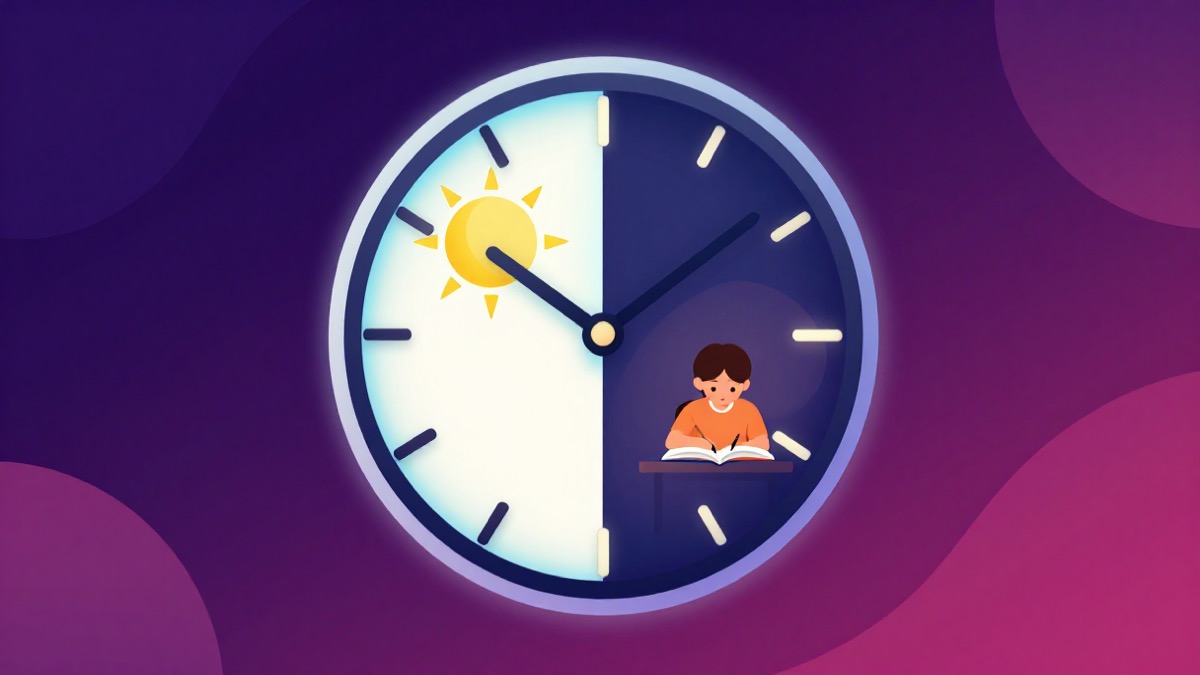
“Are you a morning person or a night owl?” sounds like small talk, but it is actually a chronobiological question with real consequences for studying. Your cognitive performance does not stay flat across the day — it rises and falls on a predictable internal schedule. Studying your hardest material during your personal peak, and light tasks in your trough, is one of the cheapest upgrades available to a study plan.
The best time of day to study depends on your circadian rhythm, and matching your hardest work to your peak alert pays off.
The Basics: Your Circadian Rhythm
Your body runs on an internal clock — the circadian rhythm — roughly 24 hours long, set primarily by light exposure and anchored in the hypothalamus. It schedules far more than sleepiness:
- Alertness typically rises through the morning after waking, peaks sometime late morning to early afternoon, dips in the mid-afternoon (the post-lunch dip is biology, not lunch), and partially recovers in the early evening before falling toward sleep.
- Core temperature follows a similar curve and correlates strongly with cognitive performance peaks.
- Melatonin onset in the evening begins the wind-down; studying against it is swimming upstream.
Superimposed on this circadian curve is a sleep-pressure curve: the longer you are awake, the more adenosine accumulates and the harder sustained focus becomes. Peak study conditions occur when circadian alertness is high and sleep pressure is moderate — typically mid-morning and early evening.
Two practical corollaries follow directly from this machinery. First, consistency amplifies everything: a regular wake time anchors all the curves, while weekend lie-ins of three hours give you Monday-morning jet lag. Second, light is the master input: bright morning light pulls your rhythms earlier and sharpens daytime alertness, while bright screens late at night push everything later and blur tomorrow’s peak. Students who fix their light exposure often find their “focus problem” was partly a timing problem all along.
Chronotypes: Lark, Owl, and the Middle Majority
People differ systematically in where their curves sit. Your chronotype — largely genetic — shifts your whole schedule earlier (larks) or later (owls):
- Larks (~15% of people) wake naturally early and peak in the morning; by evening they are spent.
- Owls (~20–25%) run one to three hours later: sluggish mornings, strong evenings, natural bedtime past midnight. Adolescents and young adults skew notably later — university owls are substantially biological, not just behavioral.
- The middle majority (~50-60%) sit between, peaking late morning and again in early evening.
Forcing an owl into 6 a.m. study sessions produces a brain operating hours below its capacity — not laziness but mismatch. Equally, larks forcing midnight cramming fight their own biology. The first practical step is honest identification: for two weeks without alarms where possible, note when you naturally wake, when focus feels effortless, when it collapses.
What Research Shows About Time-of-Day Effects
Time-of-day effects on learning are well documented and surprisingly large:
- Synchrony effects: people perform better on demanding tasks at their chronotype-preferred time of day — older adults (mostly larks) in the morning, young adults (later chronotypes) in the afternoon/evening. Mismatched testing times measurably depress performance.
- Memory encoding vs. recall: some research suggests material learned at peak times is encoded better, while certain types of retrieval may be less time-sensitive — meaning the stakes are highest for first-pass learning.
- Complex vs. routine tasks: optimal timing matters most for demanding, novel work; routine review tolerates troughs far better.
- The interesting twist for retention: a small line of research suggests some benefit to studying shortly before sleep — pre-sleep learning enjoys immediate consolidation that night. This complicates the simple “only study at your peak” rule and suggests a hybrid strategy.
The size of these effects deserves emphasis: synchrony research finds performance differences between matched and mismatched test times comparable to substantial amounts of extra preparation. In other words, studying your hardest topic in your trough can cost you what feels like hours of effort — effort you could recover simply by swapping that task into your peak window.
The Two-Peak Day: A Practical Map
For most students (middle chronotypes especially), the day offers two workable windows:
- Late morning peak (~9:00–12:00): alertness has climbed past waking grogginess, sleep pressure is still low, and willpower is fresh. This is usually the day’s best slot — reserve it for the single hardest task.
- Afternoon trough (~13:00–15:00): the circadian dip plus post-lunch effects make this the worst hour for novelty. Ideal for lunch, a walk, a nap, admin, or purely mechanical review.
- Early evening recovery (~17:00–19:00): alertness rebounds without morning’s sleep-pressure advantage gone. A second demanding block fits here — slightly weaker than morning but far better than the trough.
Owls shift this map later by one to three hours; larks earlier, with their evening recovery weaker or absent. The structure stays: find your two windows, guard them, and stop scheduling hard work inside known troughs.
A Practical Time-of-Day Study Strategy
Combine chronotype knowledge with task-matching:
- Reserve your peak window for the hardest work: new chapters, difficult problems, essay drafts. For most students this means one morning slot (9:00–12:00) and a smaller early-evening slot (17:00–19:00).
- Assign troughs the shallow work: organizing notes, formatting flashcards, admin, familiar deck review. The post-lunch dip handles spaced repetition fine.
- Exploit the pre-sleep bonus lightly: 10–15 minutes of calm review of the day’s key facts right before bed rides the consolidation wave. Keep it low-stakes and screen-free.
- Protect consistent wake times. A drifting schedule blurs every curve; regular waking anchors all of them.
- Re-check seasonally. Chronotypes shift slowly across life; your ideal slots from last year may need adjustment.
Working With (Not Against) Your Chronotype
If institutional constraints force mismatched hours — early lectures for an owl, evening classes for a lark — mitigation strategies help:
- Light management is the strongest lever. Bright light on waking shifts rhythms earlier over days-to-weeks (useful for owls); avoiding bright light in the evening prevents further drift. Morning daylight walks are the simplest intervention available.
- Do not study demanding material within an hour of waking if you are owl-typed; use that time for movement, breakfast, and shallow prep while your curve climbs.
- Negotiate exam timing where genuinely possible, or practice difficult material deliberately at the exam’s scheduled hour so the content-performance pairing is trained under realistic conditions.
- Guard your true peak ruthlessly. Whatever hours your chronotype gives you, do not donate them to email and social feeds. Peak hours are capital; spend them on what only they can accomplish.
A Sample Chronotype-Matched Day
Two quick templates make the idea concrete:
Middle chronotype:
- 09:00–11:00 — hardest new material (peak)
- 11:00–12:30 — second block: problems or drafting
- 13:00–15:00 — lunch, walk, nap, admin (trough honored)
- 17:00–18:30 — second peak: another demanding block
- 21:30–22:00 — calm summary-card review, then sleep (consolidation bonus)
Owl-typed student with 9 a.m. classes:
- Wake ~8:00, bright light immediately, movement, breakfast — no demanding study before 10:00.
- Lectures through the morning (attendance matters even at half-arousal; notes get processed later).
- 14:00–17:00 — first real deep block, as the curve climbs into its strength.
- 19:00–21:30 — second deep block: the owl’s genuine prime time.
- Wind down by 00:30; protect a consistent late wake-time anchor on weekends so the schedule survives.
Both plans share the principle: identify the two best windows biology offers, spend them only on work that needs them, and let troughs carry what troughs can carry.
Pairing Timing With Method
Timing multiplies method. A peak-hour deep block devoted to passive rereading still wastes the peak; a modest hour spent on self-testing still beats it. The full stack works together:
- Peak + deep work: hardest new material, problem-solving, writing.
- Trough + spaced repetition: light automated reviews that tolerate low arousal.
- Pre-sleep + quick retrieval: summary cards riding tonight’s consolidation.
Tools like Flaaash make the middle layer automatic — your deck resurfaces items on schedule regardless of the hour — so your scarce peak hours stay reserved for the learning only they can carry. Identify your window this week, move one hard task into it, and measure the difference.
Leave a Reply