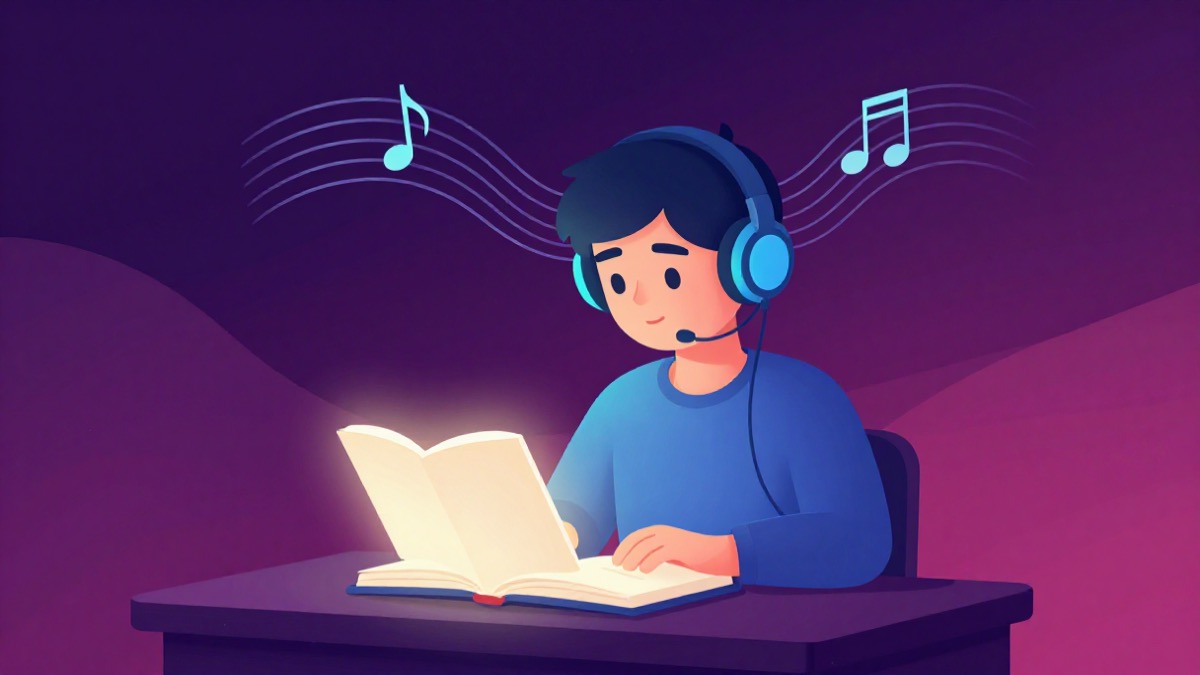
Few study habits are as contested as music. Some students swear by a playlist; others need dead silence. The science, helpfully, does not force a single answer — it explains when music helps, when it hurts, and which kinds of tasks tolerate it. Here is what research actually supports.
Music while studying is one of the most debated of all study habits, and science gives a nuanced, useful answer.
The Two Competing Effects
Music affects studying through two opposing channels, and the net result depends on which dominates for your task:
The arousal-mood channel (helps). Music elevates arousal and mood, and moderate arousal improves performance on many cognitive tasks — the classic Yerkes-Dodson relationship. A pleasant background track can keep you alert through a dull task you would otherwise abandon. This is why music often helps for tedious, repetitive work.
The interference channel (hurts). Music — especially with lyrics — competes for the same verbal working-memory resources your studies use. Reading comprehension and memorization both draw on that limited pool; lyrics pour noise into it. This is why music tends to hurt exactly the tasks that matter most for exams.
The practical consequence: music helps when the task is simple or boring and hurts when the task is verbally demanding. Neither effect is imaginary; they trade off against each other.
What Studies Show for Different Tasks
- Reading comprehension: the most consistent finding in this literature is that lyrical music impairs reading comprehension and memorization of text, while silence or instrumental sound is far less damaging.
- Memorization and flashcard review: same pattern — lyrics compete with the material you are trying to store. Silence wins for new learning.
- Problem-solving: mixed results; instrumental music at low volume rarely harms math or logic work, and can sustain effort across long sessions.
- Repetitive or administrative tasks: music reliably helps here — data entry, formatting notes, organizing files — because arousal benefits dominate while interference is minimal.
- Before studying (not during): an interesting middle path — listening to energizing music before a session raises arousal without any interference cost during it.
The Mozart Effect: Mostly Myth
The famous “Mozart makes you smarter” claim came from a 1993 study showing a brief spatial-reasoning boost after listening to Mozart — lasting about ten minutes, and later attributed mostly to arousal and mood rather than anything specific to classical music. Follow-up meta-analyses found little support for lasting IQ gains.
What survives from that literature is modest but real: enjoyable music puts you in a better, more alert state, and a better state helps the first minutes of work. If you love Baroque playlists, fine — just do not expect the music itself to build your memory. The studying does that.
Why Lyrics Are the Main Offender
The lyric effect deserves its own explanation, because it is the single most actionable finding in this literature. Understanding written or memorized material relies on the phonological loop — the component of working memory that holds verbal and sound-based information. It is a narrow channel, and lyrics pour language straight into it.
- Reading a page while hearing sung words forces two verbal streams through one channel; comprehension of one or both degrades.
- Memorizing definitions competes directly with remembered song text, producing the classic “I can only remember the chorus” effect.
- Familiar songs are worst in a sneaky way: you sing along involuntarily, and the lyrics arrive whether you want them or not.
Instrumental music occupies far less of the phonological loop — rhythm and melody are processed differently from speech — which is why lo-fi beats and film scores have become the default soundtrack of focused work. They provide arousal without stealing the verbal channel.
One nuance worth knowing: lyrics in a language you do not speak behave much more like instrumentals than like your native tongue, which is why some multilingual students can study to foreign-language vocals but not their own. And for tasks with no verbal load at all (drawing diagrams, formatting), lyrics cost little — the channel they occupy is free.
What Studies Show for Different Tasks
The two-channel model predicts different outcomes by task type, and the literature confirms them:
- Reading comprehension: the most consistent finding in this literature is that lyrical music impairs reading comprehension and memorization of text, while silence or instrumental sound is far less damaging.
- Memorization and flashcard review of new material: same pattern — lyrics compete with the material you are trying to store. Silence wins when the content is fresh.
- Problem-solving (math, logic, code): mixed results; instrumental music at low volume rarely harms this work, and can sustain effort across long sessions.
- Reviewing familiar material: lower verbal demand means lower interference — a well-known deck reviewed with a quiet playlist loses little.
- Repetitive or administrative tasks: music reliably helps here — data entry, formatting notes, organizing files — because arousal benefits dominate while interference is minimal.
- Before studying (not during): an interesting middle path — listening to energizing music before a session raises arousal without any interference cost during it.
Practical Rules for Using Music Well
- Default to silence for new material. First-pass learning, reading comprehension, and flashcards of new content get silence or neutral noise — the interference channel is real.
- Instrumental over lyrical, always. If you must have sound during demanding work: familiar, instrumental, low-tempo, low volume. Lyrics in your own language are the worst offenders; unfamiliar-language lyrics are somewhat better; instrumentals best.
- Reserve songs for the right jobs. Upbeat music for exercise before studying, for breaks, or for mindless admin — not for the chapter you are supposed to be comprehending.
- Try pink or brown noise. For focus without melody, steady broadband noise masks environmental distraction with essentially zero interference — a strong default for easily-distracted studiers.
- Match to your baseline. If you have ADHD or high trait distractibility, external stimulation like music or noise sometimes helps by occupying the part of the brain that would otherwise wander — personal experimentation beats general rules here.
Silence, Noise, and Your Environment
Beyond music, the broader acoustic environment matters:
- Unpredictable speech is the worst neighbor. Half-heard conversations (cafés, open-plan rooms) grab attention involuntarily — worse than steady music at higher volume.
- Consistent sound masks distraction. Steady noise (fan, rain sounds, brown noise) hides unpredictable interruptions, which is one reason it works so well for focused study.
- Silence is a resource, not a punishment. If you have access to genuinely quiet space for your hardest hour, spend that hour’s silence on your most demanding subject.
There is also a volume dimension students overlook: loud anything is worse than quiet anything. Loud music — even instrumental — raises physiological arousal past the optimum for complex work and physically masks your inner voice, which reading aloud in your head depends on. If you can hear yourself think, the volume is right; if you cannot, turn it down regardless of what is playing.
And consider the social-environment effect: studying near others who are visibly working (library floors, study halls) provides quiet accountability that no playlist replicates. Part of music’s real function for many students is masking an environment they cannot escape — when a truly quiet or well-populated workspace is available, it usually beats any soundtrack.
Building Your Personal Sound Policy
Rather than a blanket rule, define a small policy you apply consistently:
- Deep-work blocks (new material, reading): silence or brown noise only.
- Review blocks (familiar flashcards): instrumental playlist allowed if it keeps you going.
- Admin and organization: whatever you enjoy.
- Breaks: music freely — it aids recovery and mood without touching interference costs.
Pair the policy with your other structure (timers, planned blocks) and the question stops being daily negotiation. And once the environment is settled, remember what actually drives retention: retrieval practice on spaced schedules — something no playlist replaces. Get your deck ready, press play on silence or your favorite instrumental, and let the reviews run.
A Quick Self-Experiment Worth Running
Because individual differences here are large, a one-week self-experiment beats any general rule:
- Days 1–2: study your hardest subject in silence; note pages covered, problems solved, and how often you noticed your mind wandering.
- Days 3–4: identical material and times, but with your usual playlist.
- Days 5–6: same again with brown noise or rain sounds.
- Compare honestly. Most people find silence or steady noise wins for reading and memorization, and that their favorite playlist costs them more than it feels like — the feeling of enjoyment masks the interference. But some genuinely perform better with sound; if that is you, now you know instead of guessing.
Run the comparison once per school year; conditions and material change, and the answer is worth re-checking.
Leave a Reply