
Have you ever read a page three times and still couldn’t remember what it said? You’re not alone — and it’s not a matter of intelligence. The real problem is that most people were never taught how to memorize. They rely on re-reading and passive review, two of the least effective strategies neuroscience has ever studied. The good news: there are proven, brain-friendly methods that can change how quickly — and how durably — information sticks.
Here are 7 science-backed techniques that work, why they work, and how to start using them today.
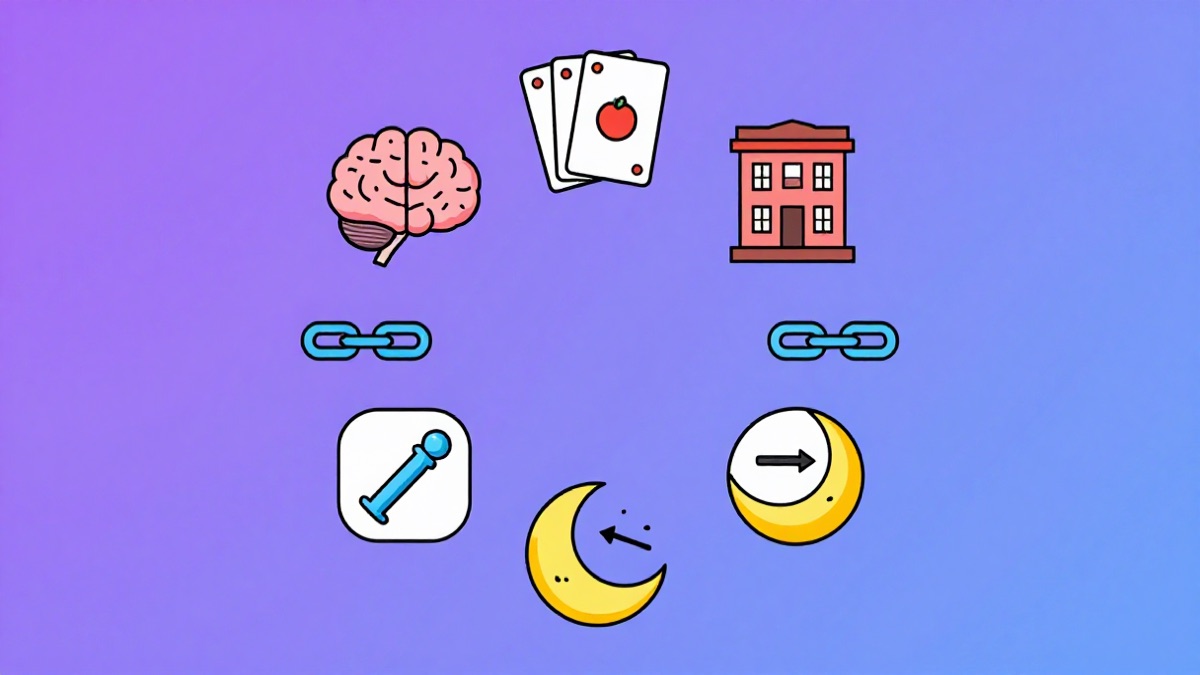
Why Most People Struggle to Memorize
The brain doesn’t store information like a hard drive. Memory is reconstructive — every time you recall something, you’re actively rebuilding it. This means the act of retrieval itself strengthens memory, not just the initial exposure.
Most students violate this principle by:
- Re-reading notes without testing themselves
- Cramming everything into one session
- Highlighting passively without engaging
Understanding how memory actually works is the first step to fixing it. Your brain responds to challenge, repetition spread over time, and emotional engagement — and the techniques below exploit all three.
1. The Memory Palace (Method of Loci)
The memory palace is one of the oldest memorization techniques in history, dating back to ancient Greece. It works by linking information to specific physical locations in a familiar space — your home, your commute, a building you know well.
How it works:
- Choose a familiar location (your apartment, your childhood home)
- Create a mental “route” through it with distinct stops
- Assign each piece of information to a stop, using vivid, unusual imagery
- To recall, mentally walk the route
This technique leverages the brain’s exceptional spatial memory — the same neural systems we evolved for navigating physical environments. Memory champions use it to memorize entire decks of cards in minutes.
Best for: Ordered lists, vocabulary, historical dates, anatomy
2. Spaced Repetition
Spaced repetition is arguably the most evidence-backed memorization method in existence. Instead of reviewing everything at once, you schedule reviews at increasing intervals — studying a concept right before you’re about to forget it.
The key insight comes from Hermann Ebbinghaus’s forgetting curve: memory decays predictably over time, but each review pushes the forgetting curve back further. Over time, intervals between reviews grow from hours to days to weeks to months.
Apps like Flaaash use AI to calculate the optimal review interval for each flashcard individually — so you spend zero time on things you already know and maximum time on what you’re about to forget.
Read our deep dive: How AI + Spaced Repetition Helps You Learn Faster
Best for: Vocabulary, formulas, facts, any large body of information
3. Active Recall
Active recall means forcing yourself to retrieve information from memory without looking at the answer first. It sounds simple — but it’s dramatically more effective than passive review.
In a landmark study, students who practiced active recall (testing themselves) retained 50% more information after a week than students who spent the same time re-reading. The reason: retrieval itself rewires the memory trace, making future recall faster and more reliable.
Practical methods:
- Close your notes and write everything you remember
- Use flashcards (answer side down)
- Teach the material out loud to an imaginary student
- Take practice tests, even before you feel ready
Learn the science behind active recall
Best for: Any subject — but especially conceptual material, languages, and exam prep
4. The Feynman Technique
Named after Nobel Prize-winning physicist Richard Feynman, this technique has one core rule: if you can’t explain it simply, you don’t understand it yet.
The four steps:
- Write the concept name at the top of a blank page
- Explain it as if teaching a 12-year-old — plain language, no jargon
- Identify where you get stuck or use vague language
- Go back to the source, fill the gaps, and simplify again
The Feynman Technique is powerful because it exposes the difference between recognizing an idea and truly knowing it. It forces deep encoding, not shallow familiarity.
Best for: Complex concepts, scientific principles, anything you need to truly understand (not just memorize)
5. Chunking
Working memory can only hold 4–7 items at once. Chunking gets around this limit by grouping individual pieces of information into meaningful clusters.
You already use chunking: when you remember a phone number as +1 (555) 867-5309 instead of eleven separate digits, that’s chunking. The same principle applies to studying.
Examples:
- Break a 20-item vocabulary list into 4 thematic clusters of 5
- Group historical events by cause → effect chains
- Learn musical scales as patterns, not individual notes
- Memorize amino acids by chemical family, not alphabetically
The key is that chunks must be meaningful — random groupings don’t help. Building on existing knowledge structures (schemas) makes each new chunk faster to form.
Best for: Large sets of information, procedural knowledge, anything with inherent structure
6. The Keyword Method
The keyword method bridges the gap between unfamiliar new information and things you already know. It’s especially powerful for learning vocabulary in a foreign language.
How it works:
- Find a keyword in your native language that sounds like the new word
- Create a vivid mental image linking the keyword to the meaning
- Retrieve the meaning by working backwards through the image
Example: The Spanish word pato (duck) sounds like “pot.” Imagine a duck sitting in a giant pot. Every time you see pato, the pot image triggers “duck.”
This technique harnesses the brain’s natural tendency to remember unusual, concrete, and emotional imagery far better than abstract text.
Best for: Foreign language vocabulary, technical terminology, medical/legal terms
7. Sleep Consolidation
This isn’t a “technique” in the traditional sense — but ignoring it undermines everything else. Sleep is when your brain consolidates short-term memories into long-term storage.
During slow-wave sleep, the hippocampus “replays” the day’s learning and transfers it to the neocortex for long-term storage. During REM sleep, the brain strengthens procedural and emotional memories.
Research-backed practices:
- Review before sleeping: material studied just before sleep consolidates better overnight
- Don’t pull all-nighters: a night of poor sleep can wipe out a day’s learning gains
- Nap strategically: a 20-minute nap after intense study boosts retention
- Consistency matters: irregular sleep schedules disrupt consolidation even when total hours are the same
Discover how neuroplasticity supports long-term learning
Best for: Everything — sleep is the biological foundation all other techniques rest on
How to Combine These Techniques
No technique works in isolation — the best learners stack them:
| Goal | Best Combination |
|---|---|
| Memorize vocabulary fast | Keyword method → Spaced repetition |
| Ace an exam | Active recall + Chunking + Sleep consolidation |
| Learn a complex concept | Feynman Technique → Active recall |
| Memorize a long list | Memory palace → Spaced repetition |
The Flaaash app combines active recall and spaced repetition in a single flashcard system, with AI that adapts review intervals to your personal forgetting curve — so you always review at exactly the right moment.
Frequently Asked Questions
How long does it take to memorize something using these techniques?
With spaced repetition and active recall, most learners see significant improvement within 2–4 weeks of consistent practice. The techniques reduce total study time while increasing retention.
Is the memory palace hard to learn?
The first memory palace takes 15–30 minutes to set up. Most people find it becomes natural after 2–3 uses. Start with a small list (5–10 items) using your home as the location.
Can these techniques help with ADHD?
Yes — techniques like chunking and spaced repetition are particularly effective for ADHD because they work with the brain’s attention patterns rather than against them. Read our ADHD guide to spaced repetition.
What’s the single most important technique for students?
Active recall, consistently. Decades of research put it above every other study strategy for long-term retention across all subjects.
Ready to put these techniques into practice? Try Flaaash — the AI-powered flashcard app that combines spaced repetition and active recall in one place.
Conclusion: Your Memory Is Trainable
Memory is not a fixed trait — it is a skill you can develop. Pick two or three techniques from this list, practice them consistently, and you will notice a dramatic improvement in how much you retain. The best technique is the one you actually use every day.
If you are learning a language, SuperNeat applies the same science to Scottish and Irish Gaelic: smart flashcards, spaced repetition, and immersive audio to get you speaking faster.
Leave a Reply